







The Hospitality Group Technology Audit
Central control. Local freedom. Clearer decisions.
Is your technology helping the group grow
or making group marketing harder?
Hospitality groups don’t set out to build a complicated technology stack. Complexity usually arrives gradually. A new property joins with its own website. One venue adopts a different voucher platform. Another team chooses a new email tool. Reporting grows through a mixture of dashboards, exports and spreadsheets. Each decision may make sense on its own, but the combined result can be difficult to manage.
The issue is not simply the number of systems. It is whether those systems work together, whether people know who owns them, and whether the group can turn their data into confident decisions. When technology is fragmented, central teams can struggle to compare performance, local teams can face slow or inconsistent processes, and guests can encounter very different journeys from one property to another.
This guide is designed to help you step back and assess the whole picture. It does not assume that every group needs one supplier or that every property should work in exactly the same way. Instead, it helps you identify where standardisation will add value, where local flexibility matters, and where disconnected tools are creating cost, risk or unnecessary work.
The goal is not fewer tools at any cost. The goal is a simpler, more connected setup that supports the way your group actually operates.
1. Why disconnected systems cost more than expected
Technology costs are easy to see on an invoice. The wider cost of fragmentation is often harder to spot. It appears in duplicated data entry, repeated training, manual reconciliation, inconsistent campaign tracking, delayed updates and reports that need explanation before anyone trusts them.
A system can be inexpensive
and still be costly if it creates manual work.
Start with the complete cost
| Cost area | Questions to ask | Evidence to collect |
|---|---|---|
| Supplier spend | What do we pay, including support and add-ons? | Contracts, invoices, renewal dates |
| People time | How much manual work does the system create? | Hours, hand-offs, repeated tasks |
| Data quality | Can we trust and compare the outputs? | Tracking gaps, discrepancies, exports |
| Change cost | How difficult would replacement or consolidation be? | Dependencies, integrations, migration needs |
2. The central control versus local flexibility challenge
A hospitality group needs consistency, but its properties also need character.
Central teams usually need governance over brand standards, security, user access, suppliers, measurement and shared campaigns. Local teams need the freedom to keep offers, events, dining information, experiences and operational details accurate and relevant.
Problems arise at either extreme. Too little central control can create duplicated spend, inconsistent branding and unreliable reporting. Too much control can create bottlenecks, flatten local personality and leave property teams unable to respond quickly to demand.
Good group technology creates guardrails, not roadblocks.
3. The Red / Amber / Green assessment
Score each technology area using the same simple model. The rating should reflect operational reality, not the strength of the supplier relationship or how long the system has been in place.
Group technology audit: systems and performance
10. Questions to ask every technology supplier
A strong supplier review should test fit, ownership and long-term value, not simply compare feature lists.
11. Build your group technology map
Before deciding what to keep, replace or consolidate, create one simple map of the current setup. Include every property and every tool that touches marketing, guest data, bookings, vouchers, content or reporting.
Do not start with replacement.
Start with visibility.
A complete map often reveals quick wins before a major procurement exercise is needed.
12. Map the stack around guest journey
Successful hospitality groups focus on guest journeys rather than systems alone. The technology stack should show how those systems support the guest journey: attracting demand, converting bookings, managing relationships and informing decisions. Viewed this way, gaps, duplication and weak connections become easier to see.
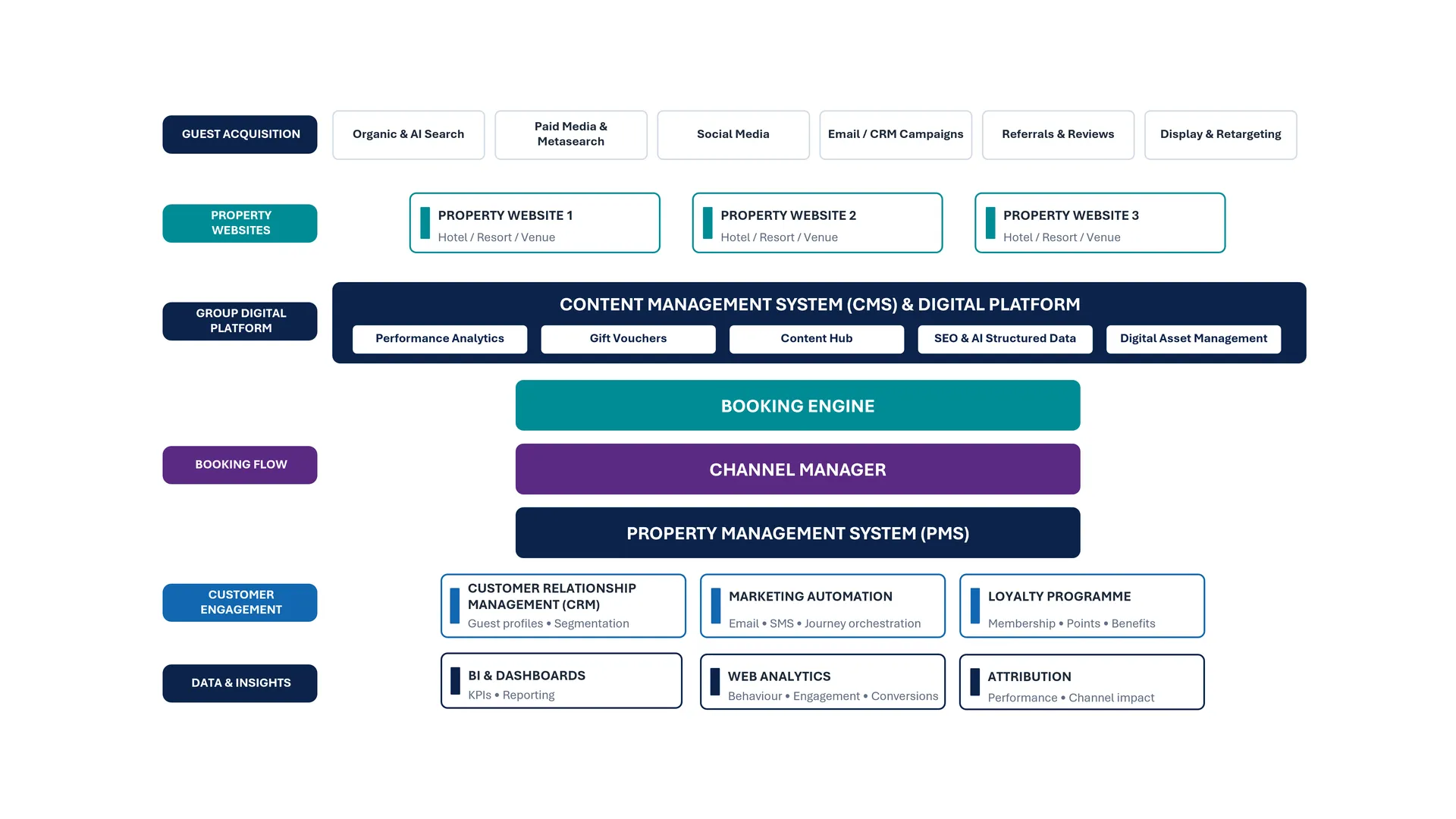
This layer-by-layer view prevents the audit from becoming a supplier list. It shows where the guest journey is supported, where data connects, and where the group is relying on manual work or assumptions.
13. What a connected group setup looks like
There is no universal architecture for every hospitality group. However, a fit-for-growth setup usually shares several characteristics:
Prioritisation rule
Address the issues that combine high commercial or operational impact with a realistic route to improvement. Not every Amber area needs a replacement project. Some may need clearer ownership, better configuration, training, documentation or a change to the surrounding process.
15. Final checklist
☐ We know every system the group is paying for.
☐ Each system has a named commercial, technical and operational owner.
☐ We understand the data moving between systems.
☐ Central and local responsibilities are clearly defined.
☐ Tracking and reporting use consistent definitions.
☐ Property teams can update the information they genuinely own.
☐ Guest data is handled consistently and responsibly.
☐ Supplier contracts, dependencies and exit requirements are documented.
☐ AI tools have a defined purpose and review process.
☐ We have a prioritised improvement plan with accountable owners.
A simpler route forward
For growing hospitality groups, technology should make the organisation easier to manage, not simply add more features. The strongest setup is one that helps central teams maintain standards and visibility while giving individual properties enough freedom to remain timely, relevant and distinctive.
That may involve consolidation, but it may also involve improving integrations, responsibilities, measurement or supplier management. The audit gives you a starting point: a clearer view of what you have, what it costs, how it is used and where it is creating friction.
Clockwork Marketing helps hospitality groups bring websites, gift vouchers, content workflows, integrations and reporting into a more coherent strategy. Our approach is built around an operational reality familiar to growing groups: the need to strengthen the group brand without erasing the character of each property.
About Pete Stevens

Content author
Pete Stevens is Head of Partnerships at Clockwork Marketing and has spent his career helping hospitality businesses get more from their marketing, technology and digital presence. Working closely with hotel groups, industry bodies and hospitality leaders across the UK, he shares practical insights on the trends, challenges and opportunities shaping the future of hospitality.
Email Pete Stevens